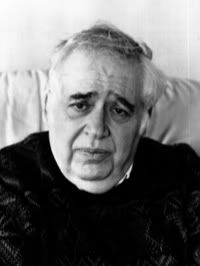
I finished reading "Jesus and Yahweh: The Names Divine." This book is a powerful illustration of the blindness of unbelief. I recently threw it in the trash because its greatest benefit is that it lets its reader into the religious mind of Bloom. Being that his mind is a confused, error-filled one, the trash was the best place for this book. Some final thoughts on this book:
1. Like most English professors, Bloom relies on assumption to define his view of the Bible. What do I mean by assumption? His assumption is that the biblical text of the OT was constructed according to the JPED theory. The biggest problem with this theory is the it assumes that the content of the OT was written by competing groups of Jews intent on emphasizing different aspects of their religion. The argument goes that the Priestly class (the P source) was interested in preserving their power through sacrifice, and that the J (Yawist) and E writers (Elohist) were also trying to maintain their power through their emphases as well. The D (Deuteronomist) writer attempted to pull these three competing strains of literature together during and after the Babylonian exile, resulting in the OT as we know it, a device they reasoned would pull all Jews together under the one "story." The reason this argument is a problem is because it remains unproven, though some of its historical/archeological observation might be true. Bloom is not critical of this argument at all. He is willing to base his world-view on faith in the observations of man (and these are not likely or clear-cut observations in the least!)
2. Bloom denies the authority of John and Paul to talk about the identity of Jesus. He completely ignores them. His reason is that these writers were not preserving Jesus' opinions of Himself--but their own, and that their theological statements do not match with the Synoptic testimonies--particularly Mark (whom Bloom accounts the earliest writer). Bloom's argument is that Mark is not presenting Jesus as God. Of course, Bloom relies on doctored liberal views of the validity of the various parts of Mark's testimony. In fact, Bloom completely misses Mark 6:50, in which Jesus says while walking on the water "It is I" (literally "I am"!). This lack of critical examination of Mark's text marks Bloom as a false teacher--one who twists and distorts the Bible. In fact, Bloom's love for Shakespeare's "Hamlet" serves as a more of a basis for his character analysis of Jesus. Similarly, Bloom takes liberties with God's OT name, quoting it as "I will be were I will be." This is convenient for a man who feels the Jews have been abandoned by God (based on events like the Holocaust). The horrible fact is that the Jews are indeed "cut off" for the present time. Of course, Satan has used events like the Holocaust to attempt to destroy them, but God has preserved their race because of the remnant Paul speaks of in Romans 9-11.
3. Bloom's last chapters will be an exercise in frustration for many Christian readers. These chapters are all about Bloom's chosen religion--Jewish gnostic mysticism.
4. "Jesus and Yahweh" serves as Bloom's testimony of and justification for his own unbelief in the end. He tries to be courteous to his reader at times, but his effort is an old man saying "this is how it is." It is dogmatic to the core.
"Jesus and Yahweh: The Names Divine" is Harold Bloom trying to play God by rewriting the truth to fit his own needs. Perhaps that is why his name is nearly as prominent on the book's cover as those of the deities he intends to address within its pages.