Showing posts with label evolution. Show all posts

Friday, March 6, 2009

Strange Facts and the Age of the Earth: Radiometric Dating and Scripture (part 6)


So far, I've noted some scientific perspectives on radiometric dating. Most scientists and many people believe the procedure has validity. Others question the scientists who use the method according to their bias, as they harmonize evidence that agrees with their assumptions of an old earth, while dismissing a lot of examples of dates that do not agree as mistakes caused by some natural process, etc.

This post is about the views of Scripture (Genesis 1) and how they harmonize with radiometric dating.

1. 7 Day Creationism: This is the oldest view of Christianity and is still held today. This position holds radiometric dating as completely false as a scientific discipline that can tell the age of the earth. Just last week I listened to John MacArthur (pastor of Grace Community) say the earth is about 6000 years old. He didn't immediately offer an explanation of his view on radiometric dating, but he was implicitly saying it offers (in its secular persuasion) no evidence for earth's age. MacArthur was relying only on Scripture. In other places, I have seen he and other 7 Day folks bring forward other objections to the method. In one such instance, MacArthur claimed that the speed of light was slowing down over time centuries. Thus, in old times, the decay of radioactive elements (the "clock" of the method), was faster, giving high ages that are false according to the true age of the earth. Additionally, those who hold this view also give credit for the fossil record to Noah's Flood. Proponents of this view staunchly declare there was no death in the world before sin (Romans 5). With this position, there is no compromise or agreement with mainstream science.
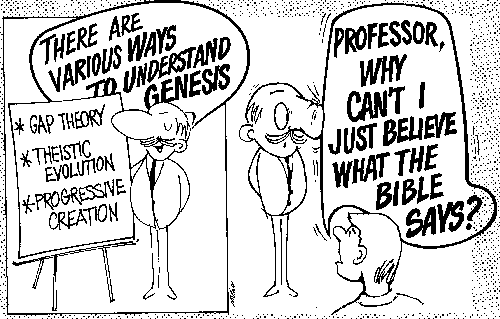


2. Theistic Evolution: This view represents a huge compromise with science on the part of Bible scholars. It assumes evolution and all old earth arguments are valid, and empties Genesis of explicit meaning. It attributes the Creation to God, and the workings of it (through NATURAL processes), but there is no Creation, save maybe the beginning of life. This view picked up steam from the middle of the 19th century on, and eventually resulted in liberal Christianity, which also allowed other sources of authority to dictate the words of the Bible (such as the social Gospel replacing the Biblical Gospel and psychology's terms and methods replacing the "soul care" that earlier generations of Bible believer's taught in regard to sin and righteousness of the believer). The weakness of this view is that makes no distinction between the strength of the scientific evidence for evolution (weak) and that for the old age of the earth (strong). The mainline denominations (Presbyterianism in the PCUSA; Anglicanism in the Episcopal Church USA; The United Methodist Church) have all either boldly or quietly accepted science's claims without reservation (though the Methodists didn't commit their position in paper until last year). Noteworthy in all this is that many proponents of the secular scientific worldview in these denominations did not start with radiometric dating as their problem, rather, it was the evolutionary worldview that started to be popular in 19th century that pushed them. Radiometric dating only strengthened their initial position. The Catholic Church has officially agreed with this position for many years.

3. Day-Age Theory: This theory is essentially the same as the above (#2) in accepting an old earth, except that the theologians who advocate it try to find harmony in the order of creation found in Genesis and that propounded by natural science. The trouble is the orders do not match up (birds before fish in Scripture versus fish before birds in science, for example). This view also does not recognize the difficulties that evolution faces. It is little different than theistic evolution.


4. The Gap Theory: Hailing from the days of the Bible teacher CI Scofield, this view inserts a "gap" between Genesis 1:2 and 1:3 that is supposed to account for all the animals and plants laid out in the earth's foundation that seem not to be part of the main part of the Genesis 1 record (1:3-end of the chapter). These creatures are supposed to be part of a world that fell after the initial creation of God, but before the rest of Genesis 1. This previous creation and fall is attributed by many proponents of this view to God creating a world for Satan (originally a beautiful, great angel) to rule. When Satan fell into sin, the world God gave him was destroyed and he was punished with eternal condemnation (to be executed finally in the Last Judgment). This view is interesting, mainly because it is creative, and possible. It is far from certain however, as it lays on shaky foundations. First, its interpretation of Genesis 1:1-3 is far from conclusive. Second, its "fall of Satan" story has little Scriptural backup. Third, it offers no interpretation of the the fossil record, which seems to show a progression of lifeforms that appear and go extinct throughout the record, from one layer of rock to another (save a few forms, which remain to this day). However, this position is compatible with an old earth as found by radiometric dating and accepts a literal Flood story, but does not lay the fossil burden on the Flood. These factors make it somewhat appealing.


5. Progressive Creationism: This view embraces the Day-Age categorization of God progressively creating life over long ages (per radiometric dating), but does not agree with evolution, because of the theory's weaknesses. However, regarding the Creation of man, many progressive creationists insist on literal historical nature of the account. This position is the best compromise (if one wants a compromise) between Scripture and available scientific data. However, many of the theories proponents do not hold to literal interpretations of certain Scriptures, specifically, the ancient history found in Genesis 1-11. This leads them in the direction of the popular "framework hypothesis" view of Scripture, which is not an origins theory proper, but is instead an explanation of Genesis as a literary description of God's real creative process, given by God to Moses for simplicity. The framework's main features are a focus on God creating all that was and is, and an attention to God's creating of the realms of existence (the land, sky, and sea) and then God filling them (the Sun for the heavens and fish for the waters for instance). This theory is still not well-known as the Day-Age Theory, but it is very interesting nonetheless, and is compatible with aspects of both the Intelligent Design movement and the Young Earth Creationist movement.


(I included the cartoons because so much information in the debate I've been writing about contains mostly rhetoric and a little bit of truth. Many Christians don't want to critically examine good arguments for an old earth and many Christians and others, including scientists don't want to critically examine the evidence for creation and the evidence against evolution.)


Thursday, December 25, 2008

Strange Facts and the Age of the Earth (Part 5) Scientific Evidence Against Radiometric Dating


This post is more difficult to write than my last two about radiometric dating. If you read those posts, you remember I said that secular geologists are uniform in their support of radiometric dating. This is true, but though I've said the evidence is very convincing, there are a lot of samples and evidence that we normally don't hear about, that are not factored into the equation of the old-earth samples, that do not agree with them. These are usually not taken seriously by scientists, who dismiss them as anomalous.

1. C-14 dating sometimes yields inaccurate dates. Christian Answers at, http://www.christiananswers.net/q-aig/aig-c007.html, says the following:
"plants discriminate against carbon dioxide containing 14C. That is, they take up less than would be expected and so they test older than they really are...Second, the ratio of 14C/12C in the atmosphere has not been constant—for example, it was higher before the industrial era when the massive burning of fossil fuels released a lot of carbon dioxide that was depleted in 14C. This would make things which died at that time appear older in terms of carbon dating."

The article goes on to say that C-14 dating is cross-referenced with history to obtain correct dates on most carbon dated items. Thus, there is uncertainty in C-14 dating, though it is a helpful dating tool.

2. Dating of radioactive rocks (K-Ar and the like) seem to have less inconsistency than C-14, but still sometimes yield dates that appear to be off the mark. Christian Answers notes one such example:

"Researchers applied posterior reasoning to the dating of Australopithecus ramidus fossils.[10] Most samples of basalt closest to the fossil-bearing strata give dates of about 23 Ma (Mega annum, million years) by the argon-argon method. The authors decided that was “too old,” according to their beliefs about the place of the fossils in the evolutionary grand scheme of things. So they looked at some basalt further removed from the fossils and selected 17 of 26 samples to get an acceptable maximum age of 4.4 Ma. The other nine samples again gave much older dates but the authors decided they must be contaminated and discarded them. That is how radiometric dating works. It is very much driven by the existing long-age world view that pervades academia today."

The conclusion in clear, the fossils bore the brunt of the weight in this dating of an ancient hominid. So, it is true that most dates off the mark are corrected for by scientists who look for evidence that is more in accord with their worldview. How much this happens is up for debate. Geologist John Woodmorappe, an ardent Creationist makes a career of documenting "adjusted evidence" like that in the paragraph above.

While almost all secular geologists form a consensus about the age of earth's rocks and fossils, it is clear that not everyone agrees. Ben Stein has made a good case in his movie "Expelled" that academia does not always form conclusions based on facts but on a prior scheme that forms the facts around a specific conclusion to be reached. That said, it still seems the arguments for radiometric dating have strong validity, though future discoveries and continued research could change things.

Monday, December 22, 2008

Strange Facts and the Age of the Earth (Part 4) Radiometric Dating's Scientific Support For


Let me by honest: radiometric dating is not out of my or your league to understand, but it is out of my league to explain it technically. Let's start by going back to our clock illustration:

1. A digital clock is observed to run dead at 12:30pm, today.
2. An expert does the math on the probable life of the battery.
3. The math indicates the clock has been running for a year.

This is the scientific essence of radiometric dating. The only difference is that the radioactive substances in the rocks of earth are the "batteries" of the clock. These substances tell how long a rock has been changing from one radioactive substance to another radioactive substance. The expert is the scientist who calculates the rock's life based on rate of change over time.

There are several forms of this dating.

1. Carbon 14-Carbon 14 is in the atmosphere. Living organsims ingest it. When they die, they stop ingestion (duh). Then C-14 starts to decay to lesser elements. The amount of C-14 left indicates at least the death point of the organism. This dating method is used widely to date young substances. Older substances are supposed to be devoid of C-14, because of its relatively short half-life. It works back a few thousand years.

2. Potassium-Argon dating is based on Potassium 40 decaying into Argon 40. It is based on exactly the same procedure as Carbon 14 dating, for the most part. It yields very old dates for some of earth's rocks (over 3 billion years).

3. Rubidium-Strontium dating is the same thing above with different elements. It too yields very old dates.

4. Isochron dating is different than the above methods. It is a "mixed bag" sample. A rock is sampled from its various component matter (crystals, and other diverse molecules). An average age is obtained from the samples using mathematics to factor in events that changed the various components of the rock over time to its various pieces. This average is a "checking mechanism" to give a better picture of the age of the whole rock.

As I said, these dating methods, on the whole, seem to be accurate, and the ones that yield old dates seem to point conclusively to an earth more than 4 billion years old. Geologists of the secular persuasion are uniform in their embrace of these methods. It is scientific dogma, and all the more, because in these cases we have actual tests (instead of unsightly conjectures--a hallmark of evolutionary biology schemes of life). I would also add that Creationists point out that some dates conflict, and seem to be in error. Other scientists are unconvinced, however, given the massive number of agreeing evidence samples.

This is all very convincing evidence to me too, even as a Christian who is historical in his interpretation of Scripture. However, I am inconclusive without further research.

Monday, December 8, 2008

Strange Facts and the Age of the Earth: Radiometric Dating (Part 3)


Radiometric dating has been around for a while now. Everyone has heard of Carbon 14 dating, a form of radiometric dating.

This method of dating earth's age amounts to a clock using atoms. Certain atoms change to other atoms over time. The amount of time to change them is called their half-life. A radioactive rock is obtained, its purity is assessed, and then it is tested to see how many atoms have changed into other atoms. The math is done for the amount of time for this process and an age of the rock is determined.

Many of these tests have been done in which earth rocks are dated to be over 3 billion years old. These tests serve as the main beachhead upon which old-earth geology is built. I can't write a long paper here, and don't want to be over-technical, so I will say straightforwardly that radiometric dating is very convincing evidence for an old earth.

However, it must be said that this method carries some big assumptions.

1. All radioactive rocks started off completely one atom type and changed to another.
2. The process has been undisturbed for eons.
3. The laws of physics have never altered.

These assumptions cannot be proven or dis-proven by science. I frankly don't know if they are true. However, I believe in a supernatural Creator who could play havoc with these assumptions. So God can do anything, and radiometric dating might give false results based on wrong assumptions that exclude God.

The alternative, which many Christian people take, is that the scientific results are correct, and Genesis is saying something different than the literal 24-hour six day theory many Creationist Christians assert. Various theories have been invented to change Genesis's interpretation to fit with old-earth scientific data, which has resulted in the "gap theory," the "day age theory," and other old-earth theories. Some of these theories are older than radiometric dating, but all give a Bible time-line that works well with an old earth.

I am still studying this issue (radiometric dating) and my conclusions are not complete. I will try to provide, in my next post, a basic pro-con argument set-up for the validity/falsity of radiometric dating according to scientific perspectives.
In a later post, I will try to address the various Scriptural theories devised based on the acceptance or rejection of radiometric results.

God's peace to you,

Greg

Friday, August 22, 2008

T-Rex flesh? (Strange facts and Earth's Age part 1)


I have long loved dinosaurs (I wanted to be a palientologist growing up), and also have had many questions about how the dinos related to my inherited Christian beliefs derived from the Bible (a possibly young earth, the Flood, etc). As a child, I often heard my father say: "A thousand years is like a day to the LORD" (a la 2 Peter 3:8) and "I don't believe we came from monkeys." All I knew for the longest time (from 5 or so to 21) was that I could come to no conclusion on this matter, having no desire to read the literature related to earth-age debate from theologians and apologists, or the scientific community.

After coming to know Christ...my desire to answer some of those old questions returned. Since then, I have read scientists like Stephen J. Gould, young-earth creationists like Henry Morris, IE theorists like William Dembski, and others in search of more information on what the Bible says about the age of the earth and what science says about its age. I have surveyed the strengths of both sets of arguments (the secular and the biblical) and also their weaknesses. What is strange is that both sides can be convincing enough to make you declare at times: "I can see truth here." However, this post is not about my conclusions on the earth's age, it is simply a demonstration of this conflict of ideas as I have encountered them.


First, there was the trip to Ripley's Aquarium at Myrtle Beach in 2003 (I realize the picture is the one in Gatlinburg, which I went to this year). That year on my honeymoon in June, walking through that fascinating display of fish, I encountered the following info on the Nurse Shark:

"Nurse Sharks carry their young and bare them live. While in the womb, the faster developing of the two babies will eventually devour the other en utero."

Horrifying? Yeah, a tad. What immediately shot through my mind was: "Life is a struggle...evolution is a struggle of selection (fittest surviving)...these sharks are already struggling in the womb...the fittest is surviving! Yikes! That's strong evidence for evolution."

I left the aquarium pondering whether evolution might be true after all from that little sign by the shark tank.

Second, there was the day I read on a science website (National Geographic no less) that palientologists had recovered (get this) intact dino flesh...and not just any dino--T REX! They found soft-tissue remains. You can read the article here:

http://news.nationalgeographic.com/news/2005/03/0324_050324_trexsofttissue.html

The day I read this, the pendulum took a hard swing toward the no-evolution, younger earth perspective. Soft tissue from an animal not thousands, but many millions of years old? Seems a little suspect. In fact, in that article, the scientist states:

"Finding these tissues in dinosaurs changes the way we think about fossilization, because our theories of how fossils are preserved don't allow for this [soft-tissue preservation]," Schweitzer said."

I am no scientist, but it don't take a genius to say it is utterly strange that meat didn't decay after 40 million years...hmmm...what could this mean? Possibly that dinos aren't as old as we thought?

Do you see the power of the examples? Course there are other examples of this play of ideas in my mind, but I won't go there, seeing this blog is getting too long already. My point would be that there is still so much we don't know scientifically, and that what side in this debate we are inclined to can be overturned quickly by a T-Rex burger or a ravenous baby shark...unless we just believe that "day" equals one solar day in Genesis.